

For more than forty years, Australia has celebrated multiculturalism as one of its great national successes. And in many ways, it is. Our cities are globally connected, our economy has been strengthened by migration, and communities from every corner of the world now call Australia home.
But beneath this success story lies a structural contradiction that few policymakers are willing to confront: Australia has successfully built a multicultural society, but it has not yet built a multicultural system of power.
The Numbers Tell the Story
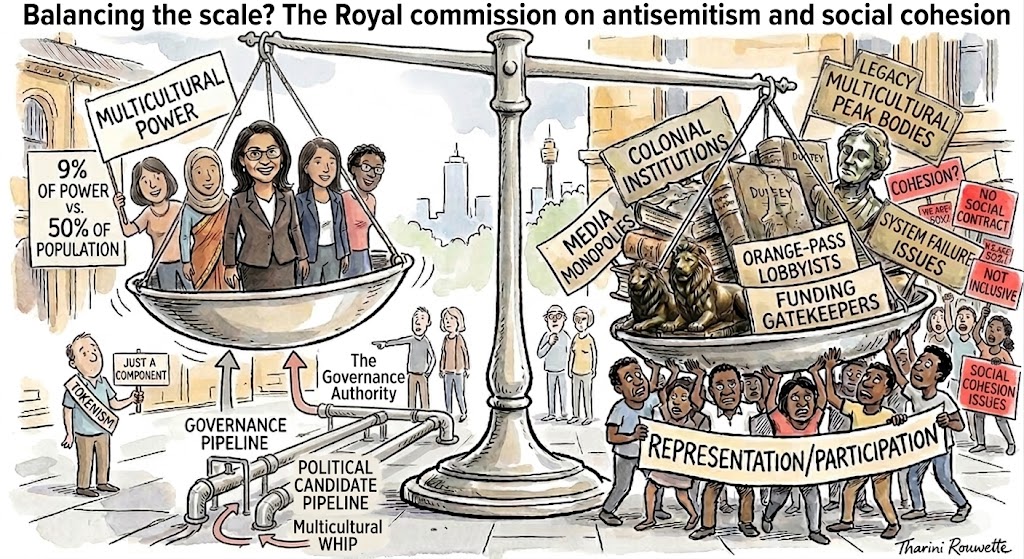
Today, roughly half of Australia’s population has a migrant background. Yet across the institutions that shape national decisions—politics, governance, media and senior administration—representation sits closer to 9 percent.
This is not a small gap. It is a structural imbalance. For decades, the assumption has been that time would solve the problem; that as communities integrate, representation would naturally follow. But that assumption misunderstands how power actually works. Power is not produced by demographic change alone. Power is produced by infrastructure.
The Infrastructure of Power
Every democratic system relies on invisible machinery that moves people into positions of authority. Political parties recruit and train candidates. Networks influence board appointments. Professional pathways feed leadership positions. Institutions reproduce their own leadership cultures.
In Australia, most of that infrastructure was built during a very different demographic era. When the country changed, the infrastructure largely remained the same. So while participation expanded dramatically, power pathways did not evolve at the same speed. This is what creates the imbalance.
Why Multicultural Advocacy Has Not Solved the Problem
For decades, governments have funded multicultural advocacy organisations. These organisations have done important work—supporting communities and providing policy input. But advocacy organisations were never designed to produce institutional power.
Advocacy operates at the level of Voice. Power operates at the level of Authority. Voice can influence decisions; Authority makes them. And authority is generated through something very specific: Pipelines.
The Missing Pipelines
Australia does not lack multicultural advocacy. What it lacks is multicultural power infrastructure. In functioning democracies, representation is produced through two parallel leadership pipelines:
- The Governance Pipeline: This pathway moves people into government boards, public service leadership, and advisory councils.
- The Political Pipeline: This pathway produces elected representatives through party candidate development, campaign infrastructure, and grassroots mobilisation.
These two pipelines reinforce each other. Elected leaders influence appointments; institutional leaders shape policy environments. Together, they produce a self-sustaining leadership ecosystem.
Australia’s Structural Gap
In Australia, both pipelines remain heavily constrained for multicultural Australians. Governance appointments often circulate within long-established networks, including Legacy Multicultural Peak Bodies and Funding Gatekeepers who have inadvertently become a “Shock Absorber” for the state, managing the 50% while the 9% continue to govern.
The result is a system where multicultural communities participate actively in society but struggle to translate that participation into authority. This is not merely symbolic; it has implications for institutional legitimacy and social cohesion. History shows that democracies cannot sustain that imbalance indefinitely.
The Next Phase of Australia’s Multicultural Story
The challenge ahead is not integration. It is institutional evolution. Our leadership structures must evolve to reflect the society they now govern. That does not happen through symbolism or rhetoric. It happens through the deliberate construction of leadership pipelines that translate participation into power.
Australia is approaching a turning point. The question is whether the structures of leadership will evolve fast enough to ensure that participation can become authority. In the long run, a democratic system cannot remain stable when half the population exists largely outside the machinery of power.
Australia does not need more conversations about diversity. It needs a serious conversation about Democratic Infrastructure. The future resilience of our institutions may depend on it.

Leave a Reply to Menaka CookeCancel reply